

Most mornings, you stand in front of your closet and reach for the same three things. The black top. The navy trousers. The grey sweater that's been washed so many times it's technically a different garment now. You're not boring — you're just exhausted by choice, and neutrals feel safe. They don't ask anything of you before coffee.
But here's the thing about playing it safe with color: nobody ever walked into a room in head-to-toe charcoal and had someone say, "Tell me about that outfit." Color is the difference between getting dressed and making a decision. And this season, the palette worth paying attention to is neither loud nor timid — it sits in that rare, useful middle ground where clothes actually look like they belong to a real person with a real life.
What follows is a practical guide to the colors gaining momentum right now, how to wear them without feeling like you're auditioning for something, the combinations that actually work together, and where to find them regardless of whether your budget is generous or laughably tight. None of this requires a wardrobe overhaul. It might require you to skip past the black section of the rack for once, which is its own small act of courage.
You Had Three Seconds, and Your Shirt Used Two of Them
Color registers before fit, before fabric, before brand. A 2012 study from Seoul National University found that people form judgments about a product — or a person — within 90 seconds, and between 62 and 90 percent of that assessment is based on color alone. Your perfectly tailored blazer doesn't get noticed until someone's brain has already filed you under "the one in the red jacket" or "someone in beige, I think."
This isn't about vanity. It's about the blunt mechanics of human attention. We process color faster than shape, which means your outfit's hue is doing work before you've opened your mouth or extended your hand. Think about the last party you attended. You can probably recall what color someone was wearing long after you've forgotten whether their pants were slim or relaxed. That's not a failure of memory — it's how vision prioritizes information.
The counterintuitive part is that wearing more color doesn't necessarily make you more memorable. Wearing the right saturation does. A muted olive will linger in someone's mind longer than a screaming lime green, because the eye can rest on it without flinching. The colors that stick are the ones that feel intentional without feeling aggressive — they suggest you thought about getting dressed for more than four seconds, without suggesting you thought about it for an hour.
This is why seasonal color trends matter even to people who claim not to follow trends. The shades that dominate a given season aren't arbitrary. They're responses to collective mood, material availability, and what designers saw gaining traction on actual streets. Paying attention to them isn't fashion obedience. It's just knowing what language everyone else is speaking so you can decide whether to join the conversation or deliberately say something different.
Butter Yellow Showed Up Uninvited and Now It Lives Here
Every season produces one color that appears everywhere at once — on runways, in shop windows, on the person ahead of you in the coffee line — until it feels less like a trend and more like a weather pattern. This season, that color is butter yellow. Not mustard, which carries the weight of 1970s sofas. Not canary, which requires sunglasses and a certain reckless confidence. Butter yellow: soft, warm, and oddly flattering on a range of skin tones that have no business looking good in yellow.
Part of its appeal is that it behaves like a neutral while technically being a color. You can wear a butter yellow linen shirt with jeans and it reads as casual, almost lazy. Swap the jeans for tailored trousers and the same shirt suddenly looks considered. That chameleonic quality is rare. Most statement colors lock you into one register — festive, corporate, weekend — and refuse to budge. Butter yellow is more cooperative than that.
It also photographs well, which shouldn't matter but does. On screens, in natural light, in the dim warmth of a restaurant, it holds its tone without washing out or turning sallow. Burgundy can look brown in bad lighting. Pale pink can disappear entirely. Butter yellow stays recognizably itself across contexts, which is why it keeps surfacing in everything from knitwear to structured bags this season.
The one catch: it shows stains like a courtroom exhibit. A single coffee drip on a butter yellow tee will announce itself to the room. If you're clumsy — and I say this as someone who has ruined two white shirts this month — consider darker pieces in this shade, or embrace the impermanence as part of the appeal. Some colors demand that you pay a little more attention while wearing them. That's not always a bad trade.
The Difference Between Wearing Color and Being Worn by It
Overdressed is not about how much color you're wearing. It's about whether the color seems to be serving you or demanding things from you. A woman in a full cobalt blue suit at a Tuesday lunch meeting looks powerful if she's relaxed in it. The same suit on someone who keeps tugging at the hem looks like the suit won the argument that morning. Confidence isn't a cliché here — it's a visible, structural component of whether an outfit works.
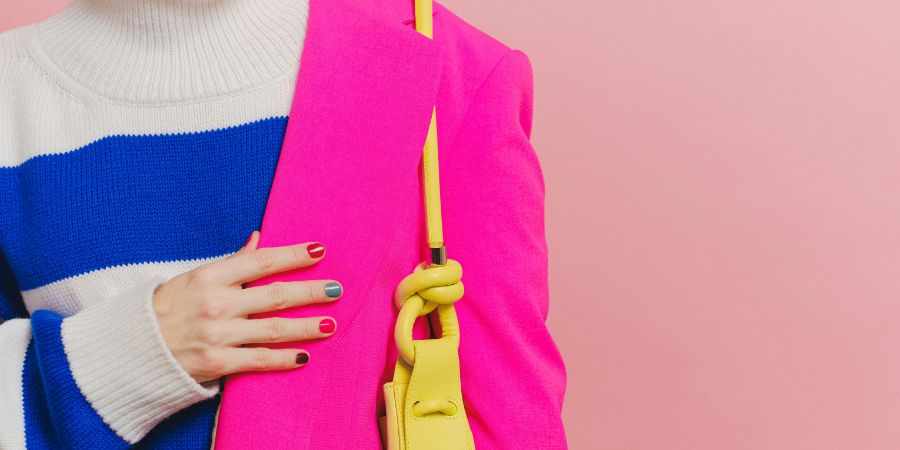
The simplest rule for wearing color without looking like you're trying too hard: keep the rest of the outfit quiet. One saturated piece surrounded by muted tones gives the eye a place to land and then relax. A terracotta blazer over a white t-shirt and dark denim asks almost nothing of the viewer. A terracotta blazer paired with emerald trousers and a patterned scarf asks them to solve a puzzle.
Fabric matters as much as shade. A bright color in a structured, shiny fabric — satin, polished cotton — reads as eveningwear even at noon. The same color in a matte, relaxed material — linen, brushed wool, soft knit — drops several formality levels instantly. If you want to wear a vivid sage green or a deep coral during the day without feeling costumed, reach for the version that doesn't reflect light back at people.
Fit plays a role too, and here's where people miscalculate. Tight, bright clothing amplifies the color's presence because it maps directly onto the body. A looser silhouette gives the color more room to breathe and reduces its visual intensity. An oversized butter yellow sweater feels approachable. A skin-tight butter yellow top feels like a very different proposition. Neither is wrong, but they're not interchangeable, and knowing the difference keeps you on the right side of the line between dressed and overdressed.
Color Pairings That Work Because They Shouldn't
The combinations that look most expensive this season aren't the safe ones. Navy and white will always work, the way a cheese sandwich will always technically be lunch — reliable, fine, forgettable. The pairings worth trying right now are the ones that create a small, productive tension between the colors, where each shade makes the other more interesting than it would be alone.
A few combinations pulling serious weight this season:
- Butter yellow and chocolate brown — warm on warm, but with enough contrast to avoid looking monochrome. A brown leather bag or belt grounds the yellow beautifully.
- Sage green and dusty rose — softer than you'd expect, and weirdly sophisticated. Works especially well when both pieces are in matte, natural fabrics.
- Terracotta and off-white — the earth-tone combination that looks deliberate rather than accidental, like you've been somewhere with better weather than here.
- Cobalt blue and charcoal — a sharper pairing that works for professional settings where full neutrals feel too safe but you're not ready to go full spectrum.
The trick with all of these is proportion. You don't want a 50/50 split between the two colors, because that creates a visual standoff with no winner. Aim for 70/30 — one dominant shade and one accent — so the eye knows where to go first. A sage green trouser with a dusty rose scarf or bag carries more purpose than a sage top with equally prominent rose bottoms.
One pairing to avoid right now: black and bright red. Not because it's ugly — it can be striking — but because it's been so thoroughly coded as "bold power outfit" by decades of magazine covers that it's almost impossible to wear without looking like you're referencing something. The best color combinations feel discovered, not quoted.
The $20 Version Exists, and It Probably Looks Fine
Seasonal colors arrive at every price point within weeks of each other now, and the gap in quality between a $30 t-shirt and a $130 one has narrowed considerably in the last decade. Fast-fashion brands monitor runway reports with the intensity of intelligence analysts, which means butter yellow tops will appear at Zara, H&M, and Uniqlo almost simultaneously with their luxury counterparts. The fabric won't drape the same way. The color might be a half-shade off. But from across a room — which is where most people are experiencing your outfit — the difference is negligible.
Where budget really matters is in outerwear and structured pieces. A cheap blazer in a trending color will show its construction within a month: puckered seams, shoulders that migrate, fabric that pills aggressively. For those pieces, secondhand shopping offers the best return. Thrift stores and resale platforms like ThredUp and Depop are flooded with quality items in seasonal colors, because someone else already made the impulse purchase and wore it twice.
If you're spending real money on one color piece this season, spend it on something you'll reach for three times a week. A well-made sage green knit. A terracotta belt in real leather. A cobalt scarf in wool or cashmere that can shift an entire neutral outfit. The per-wear cost of a $90 item you use constantly beats the per-wear cost of a $25 item that sits in a drawer after the initial thrill fades.
Outlet stores and end-of-season sales also deserve more credit than they get. Last season's trending colors don't vanish — they just get marked down. If you missed the sage green wave six months ago, it's sitting on a clearance rack right now at a price that makes experimentation painless. Being slightly behind a trend is the most cost-effective fashion strategy that nobody talks about, because it lacks the dopamine hit of being first.
Start With the Color That Solves a Problem You Already Have
The temptation is to start with the most exciting color — the one that made you pause while scrolling, the one that looks electric on someone with completely different coloring than yours. Resist that. The first color you add to your closet should be the one that fixes a gap you've been working around for months. If every outfit you own reads as dark and heavy, butter yellow or dusty rose will do more for your daily options than another shade of navy. If your wardrobe skews too casual, a structured piece in cobalt blue or deep terracotta will pull things toward polished without requiring a whole new aesthetic.
Start with a piece you'd wear at least twice a week. Not the statement dress for someday. Not the bold jacket you'll save for special occasions that never materialize. The everyday item — a top, a pair of trousers, a bag you carry to work — in a color that makes three other things in your closet suddenly make more sense together.
Try this before you buy: pull out two or three of your most-worn items and hold the new color against them. Not in theory. Physically, in front of a mirror. If it creates at least two combinations you'd actually leave the house in, it earns its place. If it only works with one thing, it's not a wardrobe addition — it's an outfit, and outfits have a short shelf life.
The color that serves you best is almost never the one you're most drawn to in isolation. It's the one that makes your existing clothes more versatile, the one that opens doors between pieces that previously had nothing to say to each other. A single well-chosen color can make a closet feel twice as large without adding a single extra hanger. That's not a small thing when you're standing there at 7:15 a.m., half-awake, reaching for black again.
Color in clothing is never purely decorative. It's a shorthand for intention — a signal to the world, and to yourself, that you didn't just grab the nearest clean thing off a chair. You chose. This season's palette makes that choice easier than most, because the trending shades are wearable, forgiving, and compatible with the kind of clothes real people already own. You don't need a new wardrobe. You need one or two pieces in a shade that wakes the rest of it up.
The best-dressed people you know probably own fewer colors than you'd guess — they've just chosen the right ones. A closet full of clothes you never wear is a storage problem. A closet with five colors that all talk to each other is a system, and systems work even on mornings when you don't.